Vibe code best practices checklist
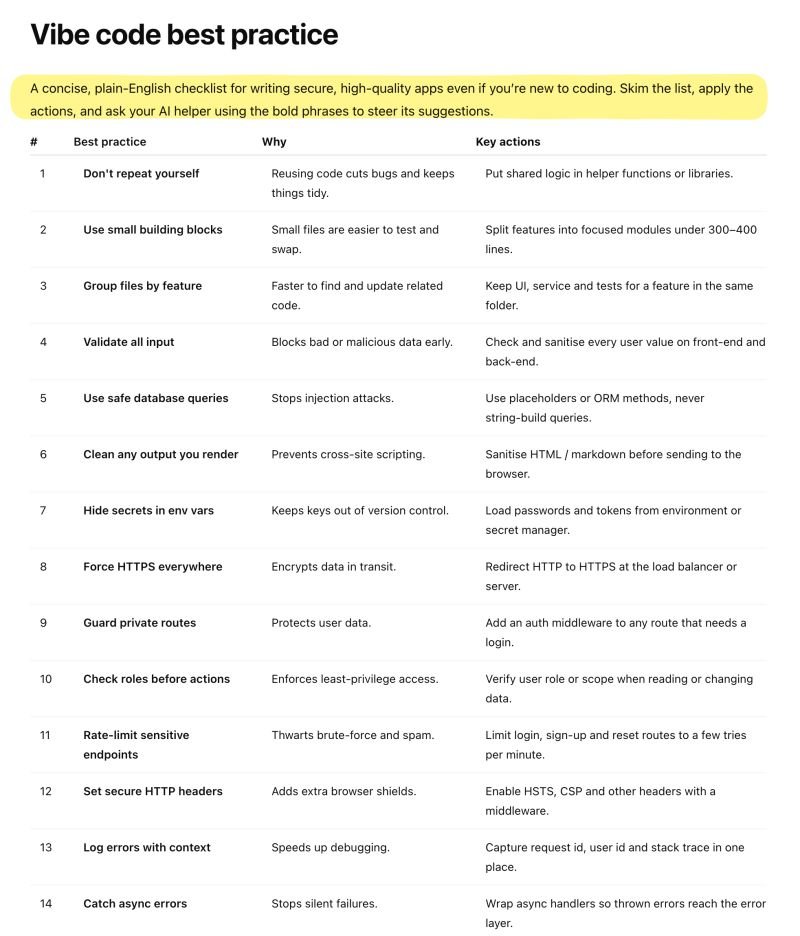
Vibe coding best practice checklist.
To help anyone write secure, high-quality apps (even if you’re new to coding):
1. Don’t repeat yourself
→ Reuse shared logic to cut bugs and clutter.
2. Use small building blocks
→ Keep files focused and under 300–400 lines for easier testing.
3. Group files by feature
→ Store UI, service and tests together so updates are fast.
4. Validate all input
→ Check and sanitise every user value on both client and server.
5. Use safe database queries
→ Parameterised queries stop SQL/NoSQL injection.
6. Clean any output you render
→ Sanitize HTML/markdown to block cross-site scripting.
7. Hide secrets in env vars
→ Keep keys and tokens out of version control.
8. Force HTTPS everywhere
→ Encrypt all data in transit.
9. Guard private routes
→ Only logged-in users reach sensitive pages.
10. Check roles before actions
→ Verify user role or scope for each restricted operation.
11. Rate-limit sensitive endpoints
→ Limit login, sign-up and reset routes to foil brute-force attacks.
12. Set secure HTTP headers
→ Enable HSTS, CSP and other headers for extra browser protection.
13. Log errors with context
→ Capture request ID, user ID and stack trace for rapid debugging.
14. Catch async errors
→ Wrap async code so rejected promises don’t crash silently.
15. Give users friendly errors
→ Show clear messages but hide technical details.
16. Cache heavy work
→ Store results of expensive tasks with sensible expiries.
17. Memoise pure functions
→ Skip rerunning deterministic calculations during renders.
18. Paginate big lists
→ Send data in pages to save memory and bandwidth.
19. Load code only when needed
→ Split non-critical bundles and fetch on demand.
20. Clean up on unmount
→ Clear timers, listeners and aborted fetches to prevent leaks.
21. Wrap related DB steps in a transaction
→ Commit or roll back all steps as one atomic unit.
22. Index hot query fields
→ Add indexes to columns you filter or join on often.
23. Use a connection pool
→ Reuse a small set of open database connections.
24. Match HTTP verbs to actions
→ GET read, POST create, PUT/PATCH update, DELETE remove.
25. Version your API routes
→ Prefix with /v1, /v2 so upgrades don’t break old clients.
26. Return structured error objects
→ Send consistent JSON like { error: { code, message } }.
27. Choose clear names
→ Use descriptive identifiers, avoid cryptic abbreviations.
28. Write why comments
→ Briefly note intent behind non-obvious code.
29. Test the core logic
→ Unit-test business rules to catch regressions early.
30. Test whole flows
→ Integration tests confirm components work together.
(Full guide in first comment below)
https://gist.github.com/iannuttall/c957fbc7cf394105a4ff5f0ac8c1ac31